

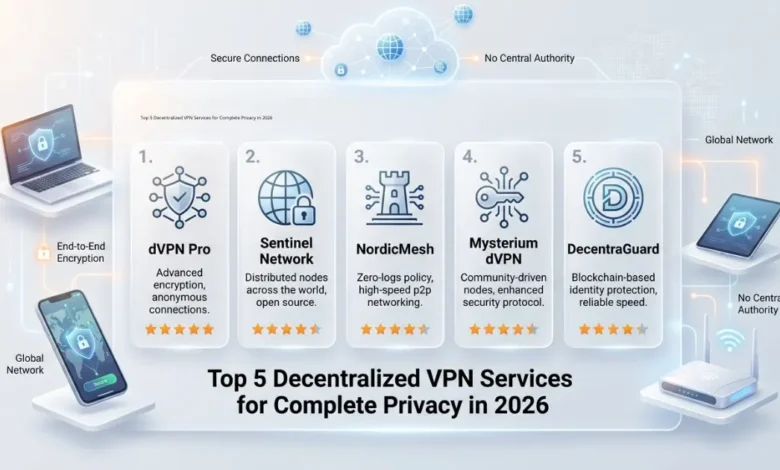
As centralized virtual private networks face increasing government regulations, mandatory data-logging laws, and server compromises, internet users are shifting toward a new paradigm of digital defense: Decentralized VPNs (dVPNs) [🚀]. Traditional VPNs route your traffic through proprietary servers owned by a single corporation. This means you must blindly trust that company not to log your data or yield to legal subpoenas.
Decentralized VPN services operate on peer-to-peer (P2P) network infrastructures, eliminating the single point of failure. Instead of routing traffic through a corporate data center, your encrypted data is sent through thousands of independent nodes hosted by global users [🚀].
This Cyber Radar evaluation reviews the top 5 decentralized VPN services in 2026 that deliver absolute cryptographic anonymity, bulletproof data privacy, and uncensored web access.

1. Mysterium Network (MYST) – Best Overall Node Ecosystem
Mysterium remains the pioneer and market leader in the decentralized privacy space, hosting one of the largest residential node ecosystems globally in 2026.
- How It Works: Built on an open-source, permissionless P2P architecture, Mysterium allows anyone to share their unused bandwidth in exchange for cryptocurrency. Your traffic is fragmented and encrypted across these residential IP addresses, making it nearly impossible for websites to detect that you are using a VPN.
- Key Features: Pay-as-you-go micro-transaction pricing, multi-hop routing capabilities, and highly effective censorship-bypassing protocols.
- Best For: Bypassing strict geo-blocks, accessing streaming libraries, and avoiding corporate tracking without subscription contracts.
Read Also:
How to Secure Your Home Router from Cyber Attacks and Data Leaks (2026)
2. Orchid (OXT) – Best for Advanced Multi-Hop Customization
Orchid is a highly secure, Ethereum-powered decentralized privacy tool designed specifically for developers, tech enthusiasts, and privacy purists.
- How It Works: Orchid operates as an open marketplace for bandwidth. Users buy bandwidth using the OXT digital asset through an advanced system called “probabilistic nano-payments.” It allows you to chain multiple dVPN providers together, bouncing your connection across completely independent networks sequentially.
- Key Features: Advanced multi-hop setups, developer-friendly API integration, and total programmatic control over your routing paths.
- Best For: Users requiring industrial-grade anonymity who want to build custom multi-layered encryption tunnels.
3. Sentinel (DVPN) – Best for Web3 Infrastructure and Speed
Sentinel is a specialized dVPN framework built on the Cosmos blockchain network, focusing heavily on delivering high-bandwidth speeds without compromising structural decentralization.
- How It Works: Sentinel allows independent developers to build and launch their own customized VPN applications on top of its secure blockchain architecture. The platform utilizes advanced wire-guard integration to ensure data packets move across global nodes with minimal latency.
- Key Features: Lightning-fast connection speeds, decentralized end-to-end bandwidth validation, and community-audited open-source code.
- Best For: High-speed video streaming, heavy web browsing, and users embedded within the Web3 and Cosmos cryptocurrency ecosystems.
4. Deeper Network (Deeper Connect) – Best Hardware-Based DPN Solution
For users who prefer a plug-and-play hardware solution rather than monthly software applications, Deeper Network offers a brilliant Decentralized Private Network (DPN).
- How It Works: Deeper Network combines enterprise-grade firewall protection with a dVPN via physical USB and inline hardware bridges (like the Deeper Connect Air/Pico). Once plugged into your home mesh router, it automatically routes your web traffic through its global decentralized network.
- Key Features: Zero subscription fees for life, integrated parental controls, 7-layer hardware firewall defense, and automated ad-blocking.
- Best For: Whole-home smart hardware protection and securing connected devices (like smart TVs and consoles) that don’t support software VPN apps.
5. Hopr (Hopr Network) – Best for Total Metadata Obfuscation
While standard VPNs encrypt the content of your data, they still leave behind a trail of network metadata (such as timestamps, data packet sizes, and routing histories). Hopr fixes this vulnerability.
- How It Works: Hopr operates a decentralized “mixnet” architecture. Not only is your data deeply encrypted, but the network also shuffles the data packets globally and introduces dummy traffic. This completely scrambles the metadata, preventing automated AI surveillance systems from tracking your online behavior patterns.
- Key Features: Full metadata privacy, incentivized node relay rewards, and deep cryptographic packet protection.
- Best For: Journalists, whistleblowers, and individuals operating under high-risk digital surveillance environments.
Centralized VPN vs. Decentralized VPN (dVPN)
| Feature Evaluation | Centralized Corporate VPNs | Decentralized P2P VPNs (dVPN) |
|---|---|---|
| Data Logging Risk | High (Dependent on corporate honesty) | Extremely Low (No central server logs data) |
| Server Ownership | Company-owned corporate data centers | Globally distributed user-hosted residential nodes |
| Payment Model | Monthly/Yearly recurring fiat credit card fees | Pay-as-you-go micro-transactions or hardware purchase |
| IP Address Block Risk | High (Streaming platforms easily blacklist data centers) | Low (Residential IPs look like organic consumer traffic) |
| Infrastructure Control | Single centralized corporate entity | Distributed open-source blockchain governance |
Final Thoughts: The Future of Digital Privacy
Decentralized VPN services represent the natural evolution of internet privacy in an age of automated surveillance and data commodification. By removing the corporate middleman and utilizing open-source peer-to-peer networks, dVPNs return data autonomy directly to the user.
If you want to maximize your local security setup, consider pairing your new dVPN configuration with an isolated home network. Learn exactly how to do this by reading our deep dive on how to secure your home router from cyber attacks to ensure your gateway is fully hardened before tunneling your traffic globally.
Discover more from Tech News Radar
Subscribe to get the latest posts sent to your email.
